Tune in as we get REAL about working in schools, serving students, and advocating for our roles. You've never heard school counseling like this.
School for School Counselors Podcast


We LOVE helping school counselors! From interviewing to learning about all the the
things they don't teach in grad school like 504, MTSS, and behavior intervention, we will help you become the most empowered & educated counselor-expert you can be!
SHARE:


OPEN IN SPOTIFY OR APPLE PODCAST:

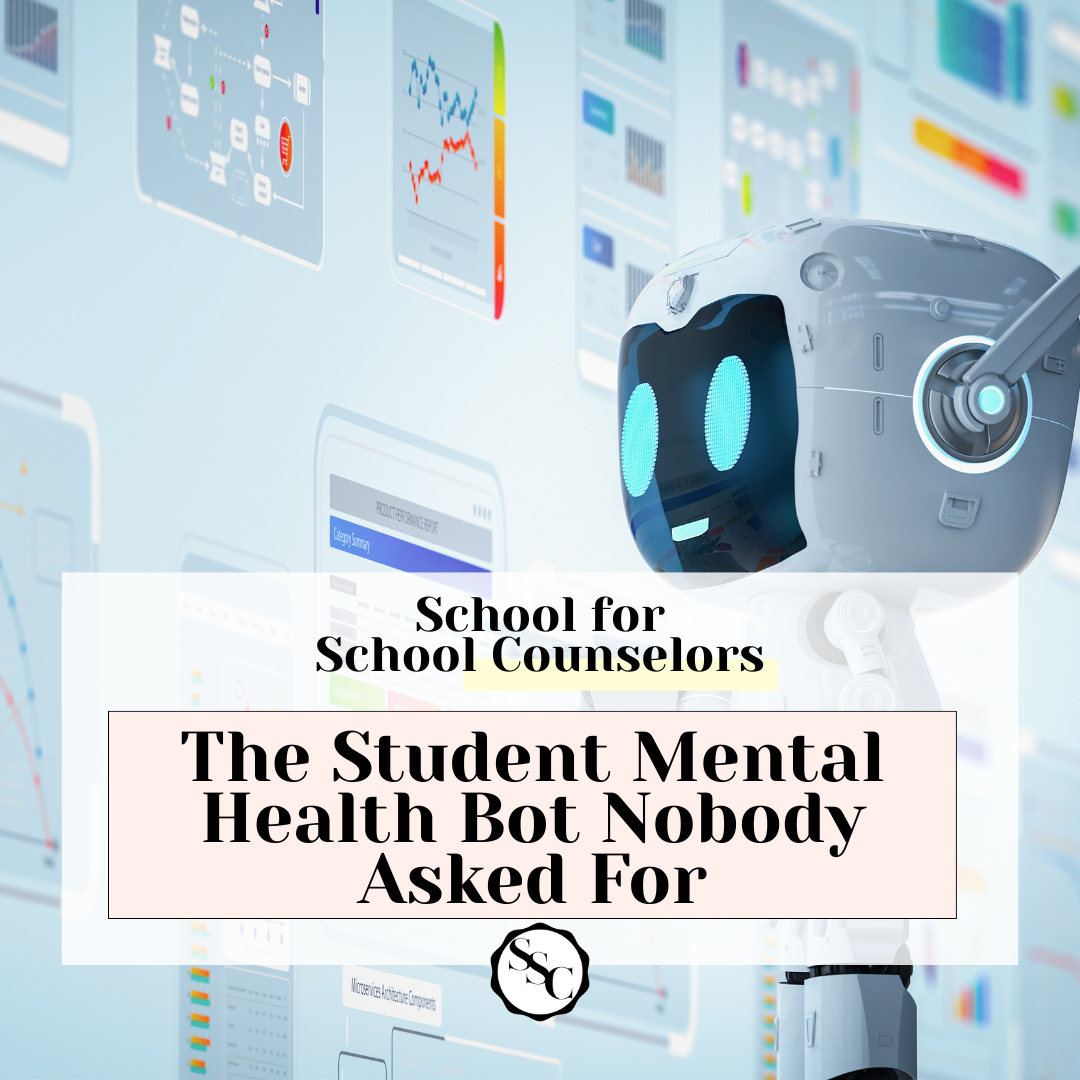
The Student Mental Health Bot Nobody Asked For
Filed under:
Artificial intelligence is rapidly making its way into schools; some platforms monitor student emails, documents, and searches for signs of distress. Others go a step further by allowing students to chat directly with AI-powered mental health bots that promise support, guidance, and crisis detection.
For overwhelmed schools facing growing student mental health needs, those products can sound incredibly appealing. After all, who wouldn’t want extra support when school counselors are already carrying impossible caseloads? The problem is that relief and effectiveness are not the same thing. Before schools begin handing student mental health responsibilities to artificial intelligence, school counselors need to ask a much harder question: Is the technology actually doing what it claims to do?
When Technology Tries to Solve a Problem Technology Helped Create
School districts across the country continue to wrestle with rising mental health concerns among students. Many of those concerns are connected, at least in part, to increased technology use, social media, cyberbullying, and constant digital engagement. Ironically, one proposed solution has been…more technology.
Companies now market AI platforms that promise to screen students for emotional distress, monitor digital communication, chat with students about anxiety and depression, alert school staff when concerns appear serious, and expand mental health support without hiring additional personnel
On the surface, that sounds efficient. Efficiency, however, is not the same as effectiveness.
What AI Mental Health Platforms Actually Do
Many schools already use software that scans school-issued devices and student accounts for language associated with suicide, self-harm, violence, bullying, or emotional distress. Newer platforms take things even further.
Instead of simply monitoring written content, students interact directly with AI chatbots that simulate supportive counseling conversations. When the chatbot determines that a student may be at significant risk, it sends an alert to school personnel… at least, that’s the promise.
The challenge is that the AI decides what qualifies as serious enough to involve a human. That decision happens before a trained school counselor ever becomes involved.
What the Research Says About AI and Student Mental Health
Artificial intelligence has made remarkable advances in many fields. Mental health assessment appears to remain one of its weakest areas. Research examining AI responses to simulated suicide risk scenarios has found that chatbots often delay referring students to human professionals until risk levels become much more severe.
Other studies comparing AI-generated suicide risk assessments to licensed mental health professionals found that AI consistently rated student risk lower than experienced clinicians. One pattern appears repeatedly. AI performs reasonably well when situations are obviously low risk or obviously high risk.
School counseling, however, rarely lives in those extremes. Most students occupy the gray area. One student may minimize their emotions while another may use humor to hide serious concerns. Others present with overlapping challenges that require clinical judgment, context, and relationship building. Those nuances are often what school counselors notice. They’re also the very things AI struggles to interpret.
Why Clinical Judgment Still Matters
School counseling has never been about matching keywords to responses. It involves reading body language and recognizing changes in behavior. It requires understanding family dynamics, building trust over time, asking follow-up questions, and knowing when something “doesn’t feel right.” Clinical judgment develops through education, supervision, experience, and ongoing professional learning.
It can’t be reduced to pattern matching alone. Students are not algorithms and neither is mental health.
Marketing Often Focuses on Efficiency, Not Outcomes
Many AI platforms are marketed using language school leaders naturally find attractive…
“Lower discipline referrals!”
“Improve attendance!”
“Return on investment.”
“Reduced workload.”
Those are important organizational goals. They are NOT clinical outcome measures. Very few marketing materials emphasize whether students actually experience meaningful improvements in mental health. Instead, many focus on operational efficiency. That distinction matters. Schools should never confuse a smoother workflow with better mental health care.
Nevada Drew a Line
One state has already addressed this issue directly. Nevada passed legislation prohibiting public schools from using artificial intelligence to perform the mental health duties of licensed professionals such as school counselors, school psychologists, and school social workers.
Schools may still use AI for administrative purposes like scheduling and record management but AI CANNOT replace the clinical role of trained mental health professionals.
That law reflects an important principle: Technology can support professional practice but it should not replace professional judgment.
An Important Question for School Counselors
School counselors often face overwhelming caseloads. When a new tool promises relief, it’s understandable to feel hopeful. Hope, however, should never replace evidence.
Before adopting any new technology, it helps to ask:
- What research supports this platform?
- What outcomes were actually studied?
- Who evaluated its effectiveness?
- What happens when the AI gets it wrong?
- Where does human judgment remain essential?
Those questions protect students… they also protect the profession.
Technology Should Support, Not Replace, School Counselors
Artificial intelligence will almost certainly become part of education’s future. Many administrative uses may save valuable time and reduce paperwork and those advances can be incredibly helpful. What deserves careful examination is the growing assumption that AI can substitute for the clinical reasoning, ethical decision making, and human relationships that define effective school counseling.
Students deserve more than automated conversations. They deserve caring professionals who recognize that every story carries context, complexity, and humanity.
Technology may become another tool in the school counselor’s toolbox… but it should never become the school counselor.
Supporting School Counselors Beyond the Podcast
Conversations like this are exactly why the School for School Counselors community exists. Every podcast episode is designed to spark deeper thinking about the profession, but the learning doesn’t stop there. If you’re looking for practical resources, ongoing professional development, and thoughtful conversations with counselors who understand the realities of today’s schools, explore the School for School Counselors Hub, browse the Blog for additional articles, and consider joining the Mastermind community. You’ll find evidence-informed strategies, collaborative problem solving, and support from professionals who are committed to strengthening both the profession and the counselors doing this important work every day.
A Note to Our Readers
Looking for a simple way to stay organized this school year? Our FREE School for School Counselors Planner was created by school counselors who understand what the job really looks like. It includes calendars, planning pages, important school counseling dates, reflection tools, and practical organizational resources without the bulk of a traditional planner. Download your free copy and start the year with a system designed specifically for school counselors.