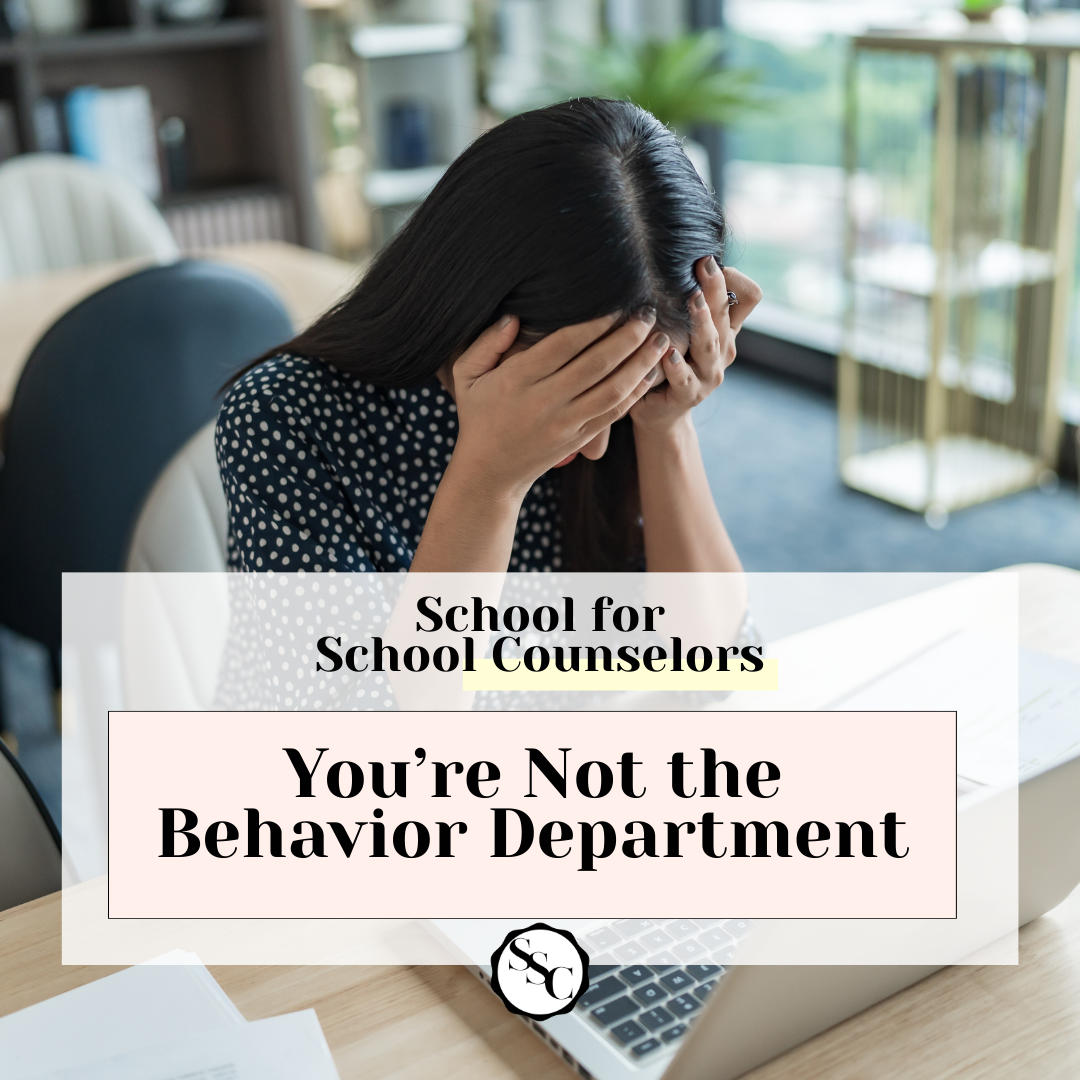
Tune in as we get REAL about working in schools, serving students, and advocating for our roles. You've never heard school counseling like this.
School for School Counselors Podcast


We LOVE helping school counselors! From interviewing to learning about all the the
things they don't teach in grad school like 504, MTSS, and behavior intervention, we will help you become the most empowered & educated counselor-expert you can be!
SHARE:


OPEN IN SPOTIFY OR APPLE PODCAST:

You’re Not the Behavior Department
Filed under:
There is a quiet shift that happens in many schools.
A student refuses to go to class.
A student yells at a teacher.
A student shuts down, melts down, or walks out.
The call goes to the counselor.
Over time, the pattern becomes expectation. When behavior shows up, the counselor is expected to absorb it. To fix it. To regulate it. To carry it. Somewhere along the way, school counselors become the behavior department.
How This Happens
It rarely starts with bad intentions. Administrators are overwhelmed. Teachers are stretched thin. Students’ needs feel bigger and more urgent every year. School counselors are trained in mental health and relationship-building, so it feels logical to send behavior concerns their way.
Logical does not mean accurate.
Behavior is communication. It can signal anxiety, trauma, skill gaps, developmental concerns, or environmental stressors. It can also reflect classroom management systems, school climate, or inconsistent expectations. When every behavioral moment is routed to the counselor, the message becomes clear: regulation is your job.
The problem is that behavior management and school counseling are not the same thing.
The Cost of Becoming the Behavior Department
When school counselors function primarily as behavior responders, several things happen.
Clinical time disappears. Preventive programming shrinks. Consultation gets replaced with crisis rotation. The counselor’s identity narrows to whoever is available in the moment. The work becomes reactive instead of strategic.
Over time, this shift erodes professional credibility. If the role looks interchangeable with assistant principal duties or crisis coverage, decision-makers begin to see it that way. The deep training in development, assessment, systems work, and mental health intervention becomes invisible.
Students still need support. Schools still need expertise. The difference is that expertise stops being obvious.
Reclaiming Your Actual Role
You are not the behavior department. You are a trained mental health professional embedded in a school system.
That means your work includes:
– Direct counseling services grounded in developmental and clinical knowledge
– Data-informed programming tied to attendance, achievement, and climate
– Consultation that helps teachers respond to behavior in sustainable ways
– Systems-level thinking that addresses root causes, not just symptoms
Consultation is often the missing piece. When a teacher calls about behavior, the first move does not always need to be pulling the student. It can be a structured conversation about patterns, triggers, skill deficits, and classroom strategies. That is clinical work. That is expertise in action.
Boundaries are not rejection. They are clarification. When you redirect behavior-only referrals into consultation, skill-building, or team-based planning, you are not refusing support. You are elevating it.
Why This Matters Now
Schools are under pressure. Student mental health needs are rising. Staffing models are shifting. Funding conversations are happening at district and state levels.
If school counselors are primarily seen as behavior managers, the profession becomes easier to dilute. Other roles can be hired to manage behavior checklists or supervise consequence systems. Very few roles are trained to integrate mental health, development, academic planning, and systemic change.
Your daily choices communicate what school counseling is.
How you frame referrals.
How you protect counseling time.
How you speak about your role in meetings.
How you use data to show impact.
Those decisions accumulate.
If this resonates, you are not alone. Many school counselors are trying to untangle years of role creep while still meeting real student needs.
This week’s podcast episode unpacks what it looks like to shift from behavior department to clinical leader inside your building. The conversation is practical and honest. It is not about becoming rigid. It is about becoming clear.
The School for School Counselors Hub, the blog, and the Mastermind exist for moments like this. They are spaces where counselors think deeply about their work, sharpen their clinical identity, and build systems that reflect their actual training.
You do not have to carry behavior for the entire building.
You are not the behavior department.
Episode Resources:
American School Counselor Association. (n.d.). School counselor roles and ratios. https://www.schoolcounselor.org/about-school-counseling/school-counselor-roles-ratios
Bardhoshi, G., Schweinle, A., & Duncan, K. (2014). Understanding the impact of school factors on school counselor burnout: a mixed-methods study. The Professional Counselor, 4(5), 426-443. https://doi.org/10.15241/gb.4.5.426.
Bardhoshi, G., & Um, B. (2021). The effects of job demands and resources on school counselor burnout: Self-efficacy as a mediator. Journal of Counseling & Development, 99(3), 289–301. https://doi.org/10.1002/jcad.12375
Burnham, J. J., Fye, H., Jackson, C. M., Ocampo, M., & Clark, L. (2024). A 20-Year review of school counselor roles: Discrepancies between actual practice and existing models. Journal of Counselor Preparation and Supervision, 18(2). https://research.library.kutztown.edu/cgi/viewcontent.cgi?article=1686&context=jcps
Council for Accreditation of Counseling and Related Educational Programs. (2024). 2024 CACREP standards. https://www.cacrep.org/wp-content/uploads/2024/04/2024-Standards-Combined-Version-4.11.2024.pdf
Horner, R. H., & Sugai, G. (2015). School-wide PBIS: An example of applied behavior analysis implemented at a scale of social importance. Behavior Analysis in Practice, 8(1), 80–85. https://pmc.ncbi.nlm.nih.gov/articles/PMC5048248/
Layden, S. J., Lorio-Barsten, D. K., Gansle, K. A., Austin, K., & Rizvi, K. (2024). Roles and responsibilities of school-based behavior analysts: A survey. Behavior Analysis in Practice, 17(1). https://journals.sagepub.com/doi/10.1177/10983007231200528
Sink, C. A. (2016). Incorporating a multi-tiered system of supports into school counselor preparation. The Professional Counselor, 6(3), 203–219. https://tpcjournal.nbcc.org/wp-content/uploads/2016/09/Pages203-219-Sink.pdf
Um, B., & Bardhoshi, G. (2024). Organizational resources, burnout, and work engagement of school counselors: The mediating effect of professional identity. Journal of Counseling & Development, 103(1), 60–70. https://onlinelibrary.wiley.com/doi/10.1002/jcad.12538
U.S. Department of Education, Office for Civil Rights. (2014). Civil rights data collection: Data snapshot (school discipline) (Issue Brief No. 1). https://civilrightsdata.ed.gov/assets/downloads/CRDC-School-Discipline-Snapshot.pdf
U.S. Department of Education, Office for Civil Rights. (2025). 2021–22 civil rights data collection: A first look. https://www.ed.gov/media/document/2021-22-crdc-first-look-report-109194.pdf