

Tune in as we get REAL about working in schools, serving students, and advocating for our roles. You've never heard school counseling like this.
School for School Counselors Podcast



We LOVE helping school counselors! From interviewing to learning about all the the
things they don't teach in grad school like 504, MTSS, and behavior intervention, we will help you become the most empowered & educated counselor-expert you can be!
SHARE:


The Catalyst Problem in School Counseling
Filed under:
National School Counseling Week and the Feeling No One Names
As National School Counseling Week approaches, appreciation posts start rolling in. Graphics go up. Maybe even T-shirts get ordered. Well-meaning messages remind you that school counselors are heroes.
And quietly, many counselors feel something very different.
Instead of feeling celebrated, they feel behind. They look at their to-do list, their caseload, and their unfinished plans and wonder why the work never seems done. Gratitude lands, but it lands on top of exhaustion. That disconnect is not a personal flaw. It’s a signal that the profession has been measured incorrectly.
The Lie of the Finish Line
School counseling has been framed around the idea that if you align enough, document enough, and advocate hard enough, you will eventually arrive at a comprehensive program. A finished product. A place where things finally feel under control. When that doesn’t happen, the internal story turns harsh. I’m not doing enough. My program does not look right. Everyone else seems to have figured this out.
Those thoughts are not rooted in incompetence or lack of care. They come from using the wrong measurement tool for the work you are actually doing.
School Counseling Is a Volatile System
School counseling operates inside one of the most dynamic systems imaginable. Students change. Staff turnover happens. Policies shift. Crises appear without warning. One small variable can alter everything.
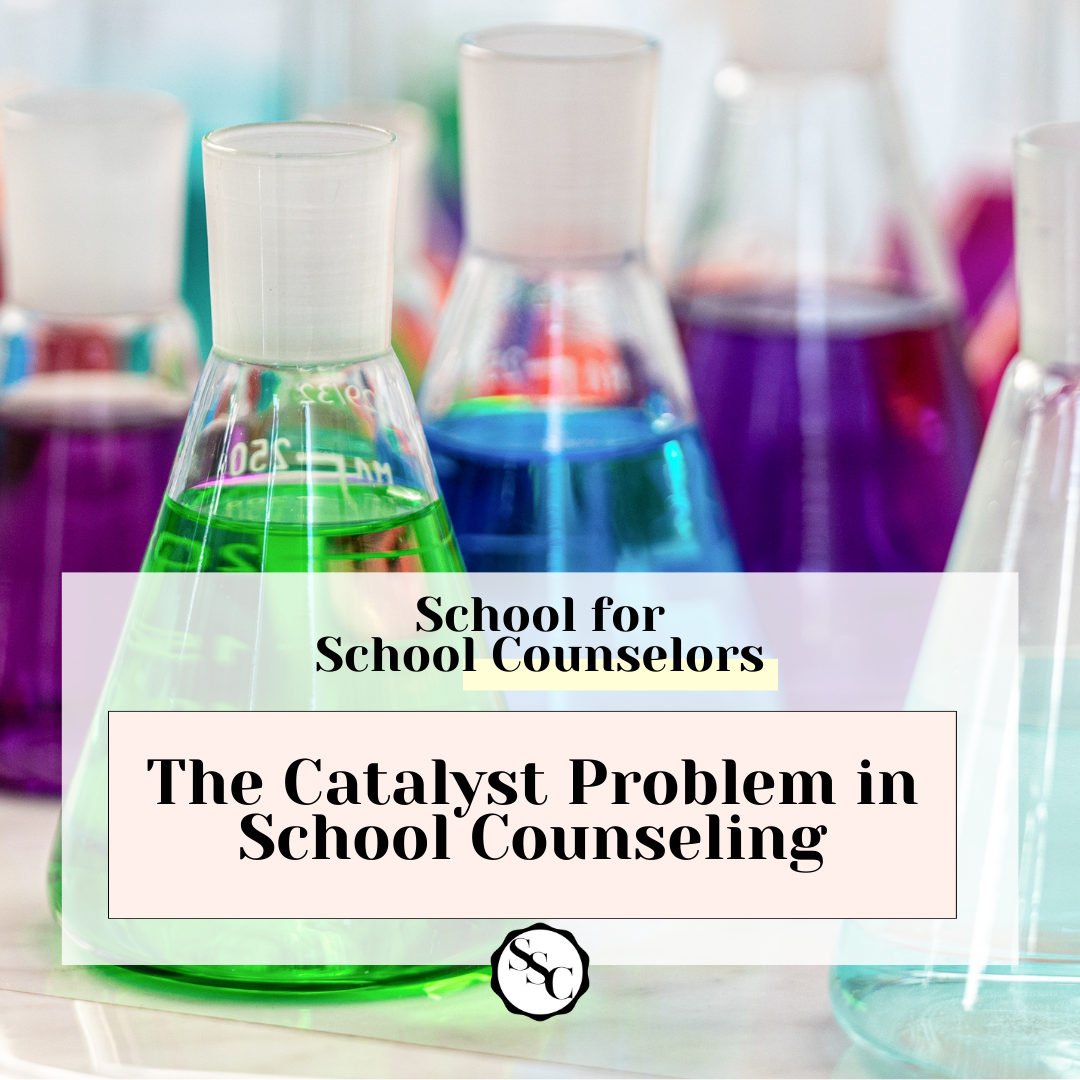
That kind of work does not behave like a checklist. It behaves more like a laboratory.
In a lab, the goal is not to arrive at a perfect final product. The work is about isolating variables, observing reactions, adjusting conditions, and learning from outcomes that could not have been predicted. Volatility is not failure. It is the work.
Catalysts Do Not Get Credit
A reaction happens when the conditions are right. A catalyst enables or speeds up that reaction without becoming part of the final product. It does not get consumed. It does not always get recognized. Often, it does not get credit at all.
That is the role school counselors play every day. You alter conditions. You remove shame. You slow things down. You create safety. You help people respond differently than they would have otherwise.
Then you move on.
Most of the time, you do not get to see what happens next.
Why Appreciation Can Feel Uncomfortable
National School Counseling Week tries to name the value of this profession, but it often does so using language that still assumes a finished product. We celebrate impact without acknowledging how invisible and ongoing the work really is.
When appreciation is layered on top of impossible expectations, it can feel hollow. Gratitude does not land well when you are still being evaluated as if this work should have an endpoint.
That tension is not ingratitude. It is moral clarity.
When Judgment Starts to Look Like Failure
When comprehensive becomes something you are supposed to finish, adaptation starts to look like deviation. Judgment calls made in response to real conditions start to feel like mistakes.
You can check every box and still miss what students need most. You can also be doing deeply effective work that does not translate neatly into an audit, a rubric, or an award application.
That does not mean the work lacks value. It means the measurement is flawed.
Effectiveness in Real Conditions
Effectiveness in school counseling is not about how complete your program looks on paper. It is about how well you are responding to the system in front of you with the resources you actually have.
When a student de-escalates because of your tone. When a parent softens because shame was removed. When a teacher pauses instead of spiraling because you slowed the moment down.
You did not implement something. You altered conditions.
That is catalytic work.
A Different Way to Hear National School Counseling Week
As National School Counseling Week approaches, what if appreciation did not ask you to prove your worth? What if it simply acknowledged the reality of the work?
School counselors are not ineffective. They are mismeasured. The exhaustion so many feel is not a sign of failure. It is a sign that the profession has been evaluated using static models inside a volatile system.
You are not behind. You are working in reality.
A Deeper Conversation on the Podcast
This week on the School for School Counselors Podcast, the conversation digs deeper into catalytic work, the myth of arrival, and why comprehensive was never meant to be a finish line. If this post resonates, the episode will help put language to experiences many counselors feel but rarely hear named.
Where to Go Next
If this perspective feels grounding, you do not have to hold it alone. The School for School Counselors Hub, the blog, and the Mastermind exist to support counselors doing real work in real systems. You do not need to arrive to belong. You just need space to keep responding well.
Inside the School for School Counselors Skool community, we keep these conversations going in real time. It’s a space for honest discussion, shared resources, and support that actually fits the realities of this job. You’re always welcome to join us there and be part of the work behind the work.
JOIN HERE!









I have never read something that I resonate so closely with. I feel completely seen in this post. What a great perspective. Thank you for that!
Thank you for the kind feedback. We are so glad we could be a voice of comfort to you! You aren’t alone!