

Tune in as we get REAL about working in schools, serving students, and advocating for our roles. You've never heard school counseling like this.
School for School Counselors Podcast



We LOVE helping school counselors! From interviewing to learning about all the the
things they don't teach in grad school like 504, MTSS, and behavior intervention, we will help you become the most empowered & educated counselor-expert you can be!
SHARE:


OPEN IN SPOTIFY OR APPLE PODCAST:

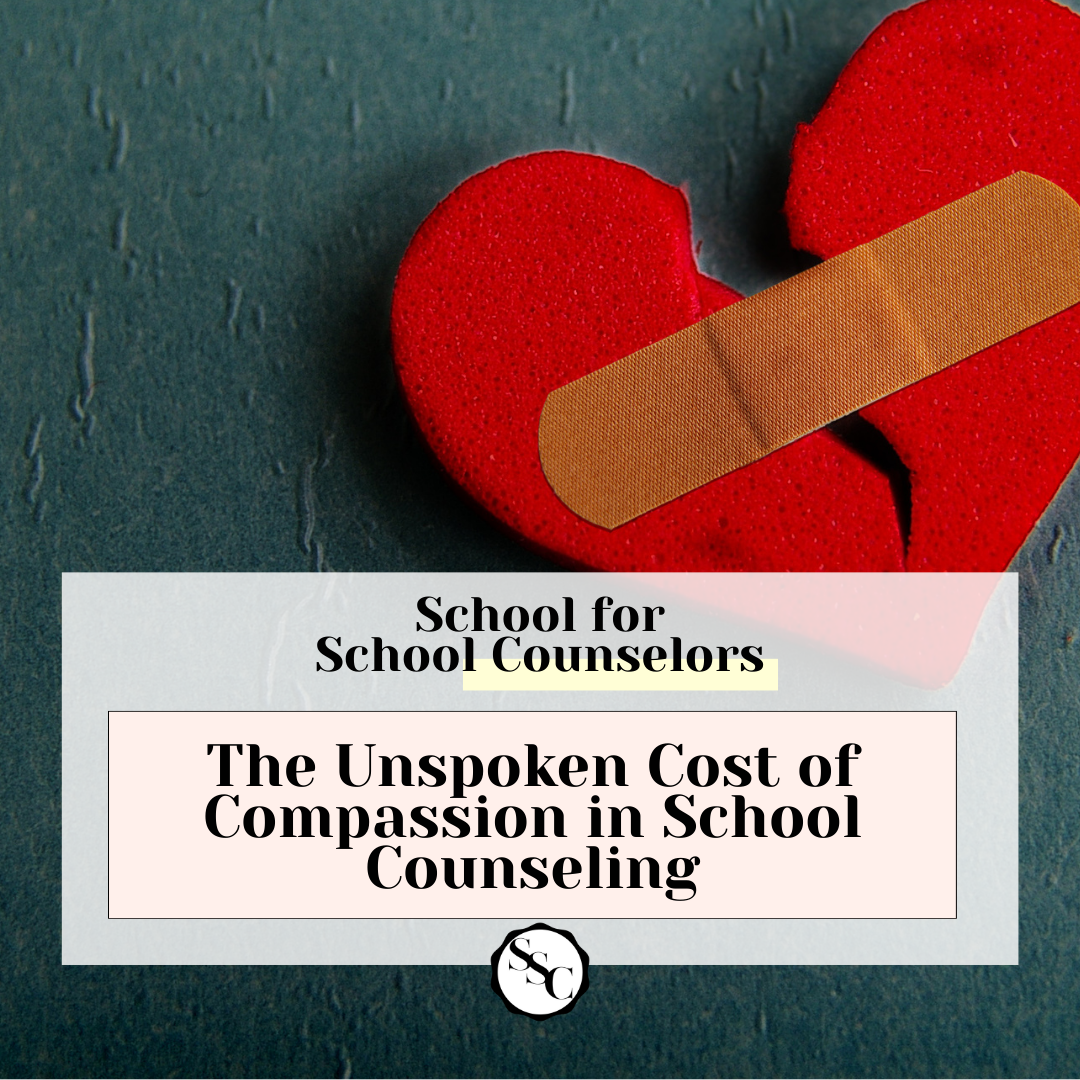
The Unspoken Cost of Compassion in School Counseling
Filed under:
When the Feeling Isn’t Burnout, Just Empty
There’s a moment many school counselors describe with the same quiet confusion. You walk out of a hard meeting. You shut your office door. You stare out the window.
You’re not crying. You’re not panicking. You’re not even hopeless. You’re just… blank.
That blankness can be unsettling because it doesn’t match the stories we’re told about burnout. You’re still showing up. You still care. You’re still doing your job well. Yet something feels off, heavier than it used to be, harder to carry than you expected.
For many school counselors, that experience isn’t burnout at all.
The Cost of Caring Has a Name
There’s a term in the research that fits this experience far better: compassion fatigue.
Compassion fatigue isn’t a diagnosis, a disorder, or a sign that something is wrong with you. Researchers describe it as the cost of caring. When your job requires you to be emotionally present, attuned, and responsive to other people’s pain over and over again, there is a price attached to that.
School counseling is full of this kind of work. You don’t just manage schedules or run programs. You hold stories. Heavy ones. You listen to disclosures. You sit with fear, grief, instability, and uncertainty on repeat. Over time, that emotional output adds up.
Why School Counselors Experience Compassion Fatigue Differently
Compassion fatigue isn’t just about what you hear. It’s also about the position you’re in while hearing it. School counselors live in an in-between space. You’re expected to think like a mental health professional, yet you often lack the authority, time, and structural support those roles are built around. You’re trusted with deeply personal information, while being limited in what you’re allowed to change.
That gap matters.
A student discloses abuse. You report it. Then you wait while the student remains in your building, still on your caseload, while systems outside your control decide what happens next.
A student struggles with severe anxiety. You know exactly what would help. There’s no therapist available, the family can’t access services, and your time is redirected elsewhere.
You see the problem clearly. You care deeply. You can’t fix it. That combination is erosive over time.
High Emotional Demand With Low Control
Research on occupational stress shows that high demand paired with low control is especially toxic. For school counselors, the demand isn’t just high. It’s emotional.
Your empathy, presence, and care are required constantly. When empathy keeps flowing out without resolution flowing back, the caring itself begins to wear you down.
This is one reason compassion fatigue often shows up in strong counselors. The ones who are competent, relational, and trusted become the emotional hub of the campus. Students seek them out. Teachers send students their way. Parents linger after meetings. Staff stop by to process something hard.
Because you’re capable, people assume you’re fine…. including you.
How Compassion Fatigue Sneaks In
Compassion fatigue doesn’t arrive loudly. It creeps in.
You notice you’ve stopped asking follow-up questions because you’re not sure you want to hear the answer. You feel a flicker of relief when a student is absent. You catch your mind drifting during a conversation that would have once held your full attention.
At night, student stories replay when you’re trying to sleep. During the day, you avoid certain conversations because you just don’t have it in you.
Physically, it can show up as chronic fatigue, tension, headaches, or sleep that never feels restorative. Because you’re still functioning, it’s easy to dismiss all of this as just stress. School counselors are very good at pushing through.
This Isn’t a Boundary Failure
Compassion fatigue is often misunderstood as poor boundaries or professional decline. In reality, it tends to show up after years of doing the work well. It’s accumulation. Every story you hold. Every crisis you absorb. Every student you care about who leaves without closure. None of those disappear. They settle layer by layer.
You don’t notice the weight building because you’re still moving forward, still helping, still showing up. One day, you realize how heavy it’s become. That realization doesn’t mean something is wrong with you. It means you’ve been carrying a lot for a long time without anywhere to set it down.
What Actually Helps
There are no quick fixes for compassion fatigue. Research consistently points to two things that matter.
The first is consultation.
Every other helping profession treats consultation as essential infrastructure. Psychologists consult. Social workers consult. Medical professionals do case rounds. School counselors are often told to set better boundaries and practice more self-care instead.
That’s not a substitute.
Humans don’t do high-stakes helping work well in isolation. Consultation provides perspective, shared understanding, and a place to process emotional load with people who understand the work without explanation.
The second is compassion satisfaction.
Compassion satisfaction is the sense of meaning that comes from noticing when your presence mattered. It doesn’t remove the hard parts, but it buffers against being consumed by them.
A student who makes eye contact for the first time.
A parent who exhales because someone listened.
A student who comes back to finish a conversation they weren’t ready for before.
Noticing these moments isn’t about fixing anything. It’s about letting your brain register the meaning of your work, not just the weight.
Naming It Changes Everything
Many school counselors make big decisions from panic because they don’t understand what’s actually happening. They leave roles that weren’t the core problem or push themselves through years that didn’t have to feel that hard. Clarity changes that.
When you stop treating emotional accumulation like a personal failure, something shifts. Not because the work suddenly becomes easy, but because you stop carrying weight that was never meant to be carried alone.
If this resonates and you want to hear this unpacked even more deeply, this week’s episode of the School for School Counselors Podcast dives into compassion fatigue, why it shows up in strong counselors, and what the research actually says helps. It’s a conversation worth sitting with if you’ve been feeling that quiet heaviness and wondering what it means.
If this resonated, you don’t have to carry it alone. Inside the School for School Counselors Hub, the blog, and the Mastermind, these conversations continue with more depth, more context, and more support. This work is heavy, and it deserves spaces that help you think clearly, process honestly, and stay connected to why you chose this profession in the first place. When you’re ready for that kind of support, it’s there for you.









This is well written and insightful. So so relatable. Thank you for writing this I am grateful that it came my way and I’ll definitely be sharing it with my colleagues.