Tune in as we get REAL about working in schools, serving students, and advocating for our roles. You've never heard school counseling like this.
School for School Counselors Podcast


We LOVE helping school counselors! From interviewing to learning about all the the
things they don't teach in grad school like 504, MTSS, and behavior intervention, we will help you become the most empowered & educated counselor-expert you can be!
SHARE:


OPEN IN SPOTIFY OR APPLE PODCAST:

Are TikTok Dances Actually School Counseling Signals?
Filed under:
The Hallway Dance Loop Isn’t What You Think It Is
You know the scene.
You’re walking down the hallway and BOOM… there they are again.
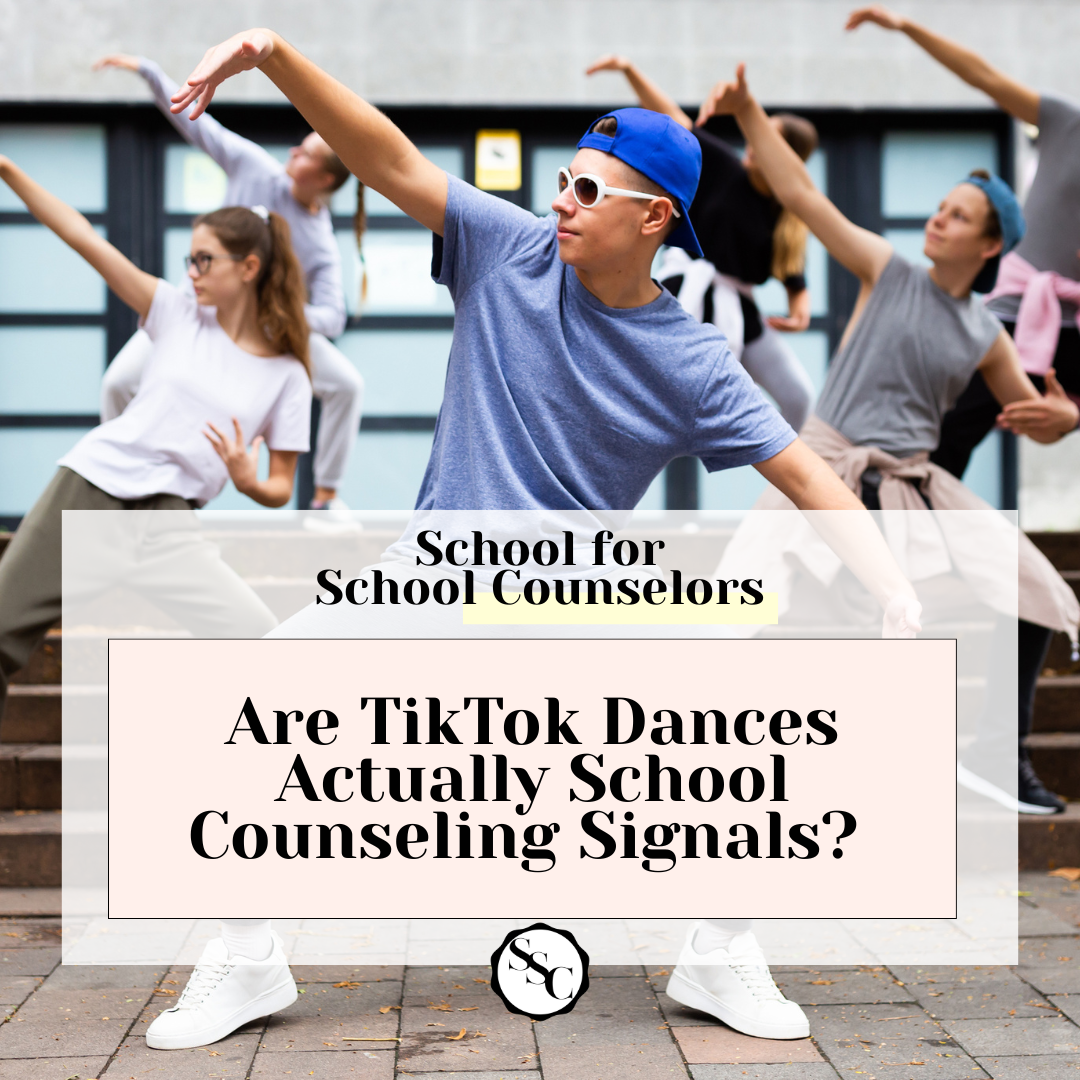
A knot of students blocking the locker row. One kid is holding the phone. Three more are windmilling their arms in what looks like coordinated chaos.
The same 10 seconds of music…
Over.
And over.
And over again.
And you think, How do they care this much about micro-bursts of choreography? Then they huddle around the phone, check the replay, exchange those tiny conspiratorial smiles… and jump right back in.
It looks like a performance, but what’s actually happening is much older, and much more human.
It’s Not About the Dance. It’s About Belonging.
What looks like random imitation is actually a survival skill. Humans have always synchronized to feel safe. We walk in step, clap together, sing together, sway together at concerts without even realizing it.
Teens?
They just happen to do it with a TikTok soundtrack.
And if you think back to your own adolescence – your Guess jeans era, your Beanie Baby confusion, whatever your “please let me fit in” moment was – you already understand the feeling underneath it.
That fragile little whisper:
Do I belong here?
Your students are carrying that question around in their bodies every single day. And sometimes, the answer comes in the form of a dance.
Why Their Brains Love Imitation
In the 1990s, Dr. Giacomo Rizzolatti discovered something wild: mirror neurons. When we watch someone move, our brains fire as if we’re moving too. That’s why kids see a dance once and instantly feel like they know it. And when they finally nail the routine?
Boom – dopamine, oxytocin, endorphins.
The brain’s “belonging cocktail.”
A 2021 study even found that synchronized movement boosts closeness even among strangers. So no – it’s not “kids today.” It’s literally how the adolescent brain wires for connection.
But Social Media Turns It Up to an 11
Of course, TikTok adds jet fuel. Every like is a hit of dopamine. Every repost becomes a tiny badge of status. Teens use social media for two things: belonging and comparison.
Sound familiar?
A dance challenge becomes a digital “Marco Polo” – a call tossed out into the world:
Do you see me? Do I count? Am I in?
And some students feel trapped by it. Like Jada, who believes, “If I don’t post, I don’t exist.” Or Kai, who can’t keep up because of spotty Wi-Fi and starts to feel like he doesn’t count.
Same dance trend.
Different level of impact.
Movement as Connection, Healing, and Human Language
For some students, synchronized movement is a lifeline. A way to belong without words. For others, it’s a battle between cultural expectations and campus culture. And for some, especially neurodivergent students, mirrored movement feels safer than conversation. But no matter the student, movement says something important:
You’re seen. You matter. You’re here with us.
I once taught dance in an elementary school and learned this firsthand after a tragic loss. When words weren’t enough, synchronized movement gave grieving students a place to breathe together. To feel together. To be held together.
Movement is belonging.
Movement is meaning.
And our students use it constantly, even when we don’t notice.
So What Do We Do With All of This?
Here’s the good news:
We don’t need to join the dance trend. (Please don’t.)
But we can do something far more powerful:
- Give students language for what’s happening in their bodies. Explain mirror neurons. Explain why imitation feels good.Knowledge gives them agency.
- Model low-stakes, offline movement. A rhythm warm-up. A silly clap pattern. A shared deep breath. These tiny rituals become anchors.
- Affirm different rhythms of belonging. Some kids belong in the dance. Some belong on the edge of it. Some belong behind the camera. Some belong beside a friend who wants nothing to do with any of it. They all count.
- Notice what the movement means. Who leads? Who follows? Who films? Who hovers on the outside, wishing they felt brave enough to join? Every part of the choreography tells a story.
A New Way to See the Hallway
So the next time you pass that same cluster of kids doing the same 10 seconds for the 37th time…
I hope you see something different.
Not chaos.
Not cringe.
Not performance.
But this: A bunch of adolescents trying, desperately and beautifully, to sync their hearts to someone else’s.
Trying to solve the oldest question there is: Where do I fit?
Because the shoulder pops and spins aren’t really about going viral. They’re about belonging—messy, rhythmic, hopeful, human belonging. If we can see that clearly, then we can anchor students in something far more stable than a trend. We can help them find the belonging that doesn’t need an audience, an app, or a replay.
Just a moment.
A rhythm.
A connection.
Human to human.
Heart to heart.